Seat pan depth for someone 6 ft 7 in
Quick answer
A 6 ft 7 in body has a buttock to popliteal length of roughly 22.1 in, so the usable seat pan depth is about 19.6 in (50 cm) once you leave 2.5 in of clearance behind the knee. A pan deeper than that stops you using the backrest, which is the single commonest fit failure in office seating.
The stature multipliers behind this table are conventions, not published standards. Two people of the same height can differ by more than an inch in leg or torso length, which is exactly why ANSI/HFES 100 specifies adjustment ranges rather than single correct numbers.
| Measurement | Figure | What it controls |
|---|---|---|
| Buttock to popliteal length | 22.1 in (56 cm) | Thigh length from the seat back to the back of the knee |
| Usable pan depth | 19.6 in (50 cm) | How deep the seat may be before it presses behind the knee |
| Clearance to leave | 2.5 in | Two to three fingers between the pan edge and the calf |
| Seat width, minimum | 21.4 in (54 cm) | Hip and thigh room without the armrests fouling |
| Pan depth | Verdict for this body | What happens |
|---|---|---|
| 15.5 in | Usable | Supports the thigh with clearance to spare. |
| 17.0 in | Usable | A good match for this leg length. |
| 18.5 in | Usable | Comfortable, with full thigh support. |
| 20.0 in | Too deep | Far too deep for this body. |
Chairs with adjustable pans, across the range
Shown across the range this category actually spans, from $16.96 to $1585.00, rather than the cheapest few.
- TranquilRelax
TranquilRelax Memory Foam Seat Cushion for Office Chair, 3-Inch, Black
$16.96 Check pricePrices change often - Haworth
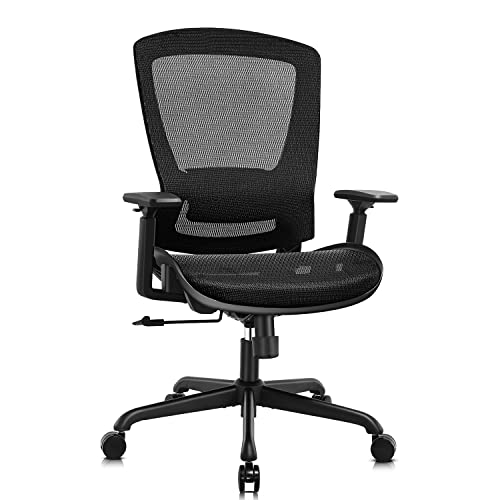
Haworth Fern Ergonomic Office Chair w/Breathable Mesh, Lumbar, Coal
$1,130.00 Check pricePrices change often - Haworth
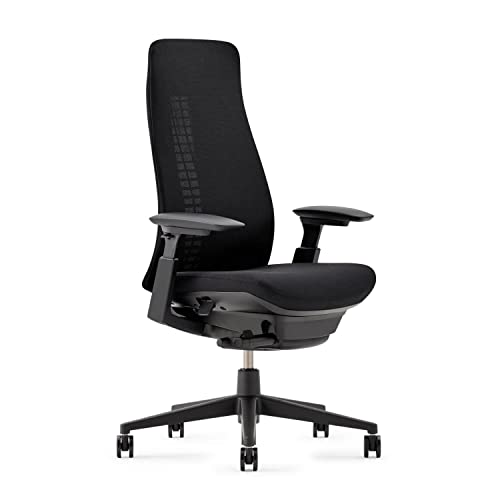
Haworth Fern Ergonomic Office Chair, Digital Knit, Lumbar, Ember
$1,585.00 Check pricePrices change often




Why a seat that is too deep ruins a good chair
If the pan is deeper than your thigh is long, the front edge presses into the back of your calf whenever you sit right back. So you do not sit right back. You perch forward instead, which puts you out of contact with the backrest and makes the lumbar support, the recline mechanism and most of what you paid for irrelevant. A superb chair that is too deep performs worse than a modest chair that fits.
For a 6 ft 7 in body the usable depth is about 19.6 in. The check takes a moment: sit fully back against the backrest, then see whether you can fit two or three fingers flat between the front edge of the seat and the back of your calf. Less than that and the pan is too deep. Much more and the thigh is losing support it should have.
What to look for instead
A sliding or adjustable seat pan is the feature that solves this, and it is the one worth paying for if your leg length is not average for your height. It typically offers 2 to 3 in of travel, which is enough to take a single chair from fitting a short legged user to fitting a long legged one. On a shared desk it is close to essential.
Waterfall front edges help but do not substitute. A rolled or waterfall edge reduces the pressure a slightly deep pan puts on the calf, which makes a small mismatch tolerable. It does not fix a pan that is 3 in too deep, because the geometry problem remains: you still cannot reach the backrest without the edge meeting your leg.
Questions people ask
How deep should a chair seat be for someone 6 ft 7 in?
About 19.6 in (50 cm) of usable pan depth. That comes from a buttock to popliteal length of roughly 22.1 in for this height, less 2.5 in of clearance so the front edge never presses into the back of the calf. Sit fully back and check for two to three fingers of gap.
What happens if the seat is too deep?
You stop using the backrest. Sitting fully back drives the pan edge into your calf, so instead you perch forward, and from there the lumbar support and recline do nothing at all. It is the most common fit failure in office seating and it makes an expensive chair perform worse than a cheap one that fits.
Is an adjustable seat pan worth paying for?
If your leg length is not average for your height, or the chair is shared, it is the single most useful adjustment on the chair. A sliding pan usually offers 2 to 3 in of travel, which is the difference between fitting a short legged and a long legged user. If the fixed depth already matches you, it adds little.
Does a waterfall seat edge fix a deep seat?
It helps with a small mismatch and cannot fix a large one. A rounded or waterfall front edge lowers the pressure on the underside of the thigh and behind the knee, which makes a pan that is slightly deep tolerable. If the pan is several inches too deep the geometry is unchanged: reaching the backrest still puts the edge against your leg.