Best Anti-Fatigue Mats
Quick answer
The ComfiLife Anti Fatigue Floor Mat ($44.99) is the best all around mat for standing desk use, offering a 3/4 inch thick flat cushioned surface at a low price. For a mat designed to encourage foot movement rather than just cushion standing, the Ergodriven Topo ($109.00) with its contoured terrain is the ceiling pick.
Picks are researched from published manufacturer specifications and verified owner reviews. We did not test these mats in person.
An anti-fatigue mat is a cushioned floor pad placed where you stand at a standing desk, meant to reduce the leg and lower back fatigue that comes from standing on a hard floor for long stretches. Our pick, the ComfiLife Anti Fatigue Floor Mat at $44.99, is a straightforward 3/4 inch thick flat mat that covers the basics well without asking you to adapt to a contoured surface. It is one of the smaller purchases in a home office setup, but for anyone standing for real stretches of the day, it is also one of the purchases most likely to be felt immediately.
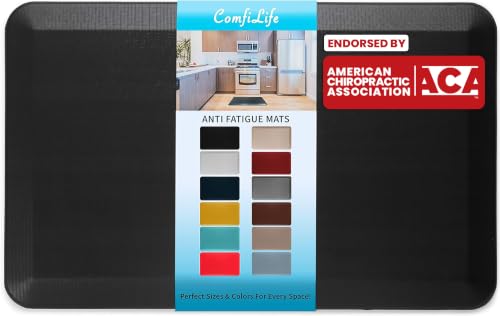
ComfiLife Anti Fatigue Floor Mat, 3/4 Inch Thick Kitchen Mats for Floor, Standing Desk Mat, Kitchen Rug, Comfort at Home, Office, Durable, Stain Resistant, Non-Slip Bottom (20" x 32", Black)
A flat 3/4 inch thick cushioned mat at 20x32 inches, wide enough for a natural stance shift and priced well below the contoured options.
The three tiers
Ergohead Anti Fatigue Kitchen Floor Mat Comfort Standing Mat, Portable Office Standing Desk Mat, Multi-Purpose Kitchen Rug, Built-in Handle with Massage Points Comfort Floor Mat (Black, 17" x 22")
The Ergohead Anti Fatigue Kitchen Floor Mat at $24.99 is a portable 17x22 inch mat with a built-in carry handle, the cheapest entry point in this roundup.
The trade off: At 17x22 inches, it is the smallest mat here, which limits how far you can shift your stance before stepping off its edge.

ComfiLife Anti Fatigue Floor Mat, 3/4 Inch Thick Kitchen Mats for Floor, Standing Desk Mat, Kitchen Rug, Comfort at Home, Office, Durable, Stain Resistant, Non-Slip Bottom (20" x 32", Black)
The ComfiLife Anti Fatigue Floor Mat at $44.99 is a flat 3/4 inch thick mat at 20x32 inches, sized for a real standing zone rather than a single fixed foot position.
The trade off: It is a flat surface rather than a contoured one, so it cushions standing but does not actively encourage foot and calf movement the way a terrain-style mat does.
The Standing Desk Mat - Topo by Ergodriven | Premium Not-Flat Anti-Fatigue Standing Desk Mat with Calculated Terrain | Ultra-Thick Deluxe Comfort Foam, Durable, PVC-Free | Accessories | Obsidian Black
The Ergodriven Topo at $109.00 uses a contoured, not-flat surface designed to invite small shifts in foot position throughout the day, which is a different approach than a simple cushioned pad.
The trade off: The contoured terrain takes some adjustment, and it costs more than twice the flat ComfiLife mat for a design built around active foot movement rather than passive cushioning.
Who should not buy it: Buyers who want a simple flat surface to stand on rather than a textured, terrain-style mat.

How we chose
We did not test these mats in person. Every claim here comes from the manufacturer specification sheet, focused on thickness, dimensions, and surface design, since those three factors are what actually differentiate anti-fatigue mats at different price points, along with a reading of verified owner reviews for durability and any reported off-gassing smell on arrival.
We separated flat cushioned mats from contoured, terrain-style mats deliberately, since they solve the same problem, reducing standing fatigue, in different ways, and a buyer choosing between them should understand that distinction rather than assume the pricier option is simply a thicker version of the cheaper one.
What does an anti-fatigue mat actually do?
Standing on a hard floor for long periods concentrates pressure on the same points of your feet and can stiffen the lower back and legs over the course of a day. An anti-fatigue mat cushions that contact point and, in the case of contoured designs, encourages small shifts in foot position and posture, which keeps blood flowing rather than letting you settle into one fixed stance for hours.
A mat does not replace the benefit of actually alternating between sitting and standing at a height adjustable desk; it addresses the fatigue that builds up during the standing portion of your day, and it is a low cost complement to a standing desk rather than a substitute for taking sitting breaks during a long shift.
| Mat | Size | Design | Price |
|---|---|---|---|
| Ergohead Portable | 17x22 in | Flat, with carry handle | $24.99 |
| FEATOL Anti Fatigue Mat | Extra thick | Flat | $44.99 |
| ComfiLife Anti Fatigue Floor Mat | 20x32 in | Flat, 3/4 in thick | $44.99 |
| Ergodriven Topo Mini | Smaller | Contoured terrain | $79.00 |
| Ergodriven Topo | Standard | Contoured terrain | $109.00 |
What size mat do I actually need?
A mat should be roughly as wide as your natural stance shift, not just as wide as your feet standing still. A 17x22 inch mat, like the Ergohead in our starter tier, suits a fixed position in front of a keyboard, while a 20x32 inch mat, like the ComfiLife, gives room to shift toward a monitor to one side or step slightly forward and back during the day.
If your standing desk is wide, such as an L-shaped or large desk where you move between zones, consider whether one larger mat or two smaller mats better matches how you actually move across the desk.
Flat mat or contoured mat: which is better?
A flat mat, like the ComfiLife or FEATOL in this roundup, cushions your feet in whatever position you naturally stand, which suits people who prefer a stable, predictable surface. A contoured mat, like the Ergodriven Topo, uses raised and lowered terrain to invite small, frequent shifts in foot position, based on the idea that varying your posture throughout the day reduces fatigue more than cushioning alone.
Neither approach is objectively correct for every person. Some owner reviews describe an adjustment period standing on a contoured mat before it feels comfortable, while flat mats have no learning curve but rely entirely on cushioning material to do the work.
How thick should an anti-fatigue mat be?
Thickness in this roundup ranges from a standard flat pad up to 3/4 inch on the ComfiLife, with the FEATOL marketed as extra thick, and the Ergodriven models using their own contoured foam profile rather than a single flat thickness measurement. A thicker flat mat generally cushions more but can feel less stable underfoot for people who prefer a firmer stance, particularly if you also stand on the mat while doing anything requiring balance, like reaching overhead.
If you spend most of the day standing rather than shifting between sitting and standing frequently, a thicker mat is generally worth the tradeoff in stability. If you switch positions often, a moderate thickness that does not feel unstable when stepping on and off is usually the better fit.
Does an anti-fatigue mat wear out, and how do I know when to replace one?
Foam cushioning in any mat compresses gradually with daily use, and a mat that has visibly flattened in the areas where you stand most, or that no longer springs back after you step off, has lost most of its cushioning benefit even if it looks intact otherwise. Owner reviews are the most useful source for how long a specific mat holds its cushioning under daily use, since manufacturers rarely publish a compression lifespan figure.
A portable mat with a carry handle, like the Ergohead in our starter tier, is also easier to rotate between multiple standing locations, such as a desk and a kitchen counter, which can extend its useful life compared with a mat that stays in one spot permanently and takes the same daily wear in the same few square inches.
Shop anti-fatigue mats
Shown across the range this category actually spans, from $24.99 to $109.00, rather than the cheapest few.
- FEATOL
FEATOL Anti Fatigue Mat for Standing Desk & Kitchen Floor, 9/10 Extra Thick
$44.99 Check pricePrices change often


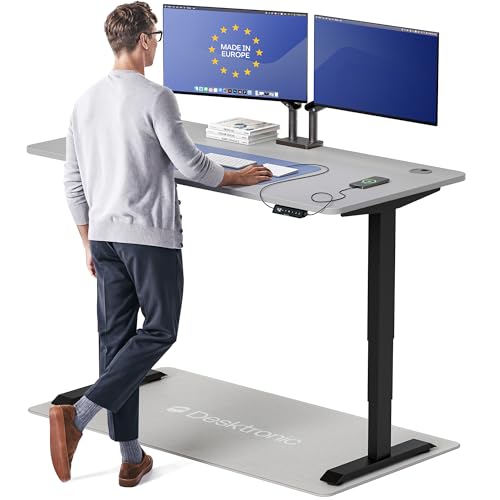
Standing desks to pair with a mat
Shown across the range this category actually spans, from $99.98 to $679.99, rather than the cheapest few.
- FEZIBO
FEZIBO Standing Desk 48 × 24 Inch Electric Height Adjustable, Maple
$99.98 Check pricePrices change often


Buying tips
- Size the mat to your natural stance shift, not just your feet standing still, especially on a wide or L-shaped desk.
- Decide between a flat cushioned mat and a contoured terrain mat based on whether you want a predictable surface or one that encourages foot movement.
- Expect a short adjustment period on a contoured mat like the Ergodriven Topo if you have only used flat mats before.
- Watch for visible flattening in your standing area as the sign a mat has lost most of its cushioning, since foam compresses gradually with daily use.
Get the desk setup checklist
One page: the measurements to take, the order to set them in, and the numbers to check against. Free, no spam.
The mailing list opens shortly. Every measurement it covers is already on this site, in the calculators and the fit tables, at no cost and with no address required.
Questions people ask
Do I need an anti-fatigue mat if I already have a standing desk?
It is not strictly required, since alternating between sitting and standing already reduces the fatigue of standing all day, but a mat adds cushioning for the time you do spend standing, particularly on hard flooring like tile, laminate, or concrete. Carpeted floors provide some natural cushioning already, which is worth factoring in before buying a thick mat you may not need.
What is the difference between a kitchen anti-fatigue mat and a standing desk mat?
Functionally, many mats marketed for kitchens and standing desks use similar cushioned foam construction, and several mats in this roundup are explicitly marketed for both uses. The main differences tend to be size, some kitchen mats run narrower, and surface texture, since a desk mat sees less spill exposure than a kitchen mat typically does.
Are contoured anti-fatigue mats worth the higher price?
That depends on whether you want a mat that actively encourages movement or one that simply cushions a fixed stance. The Ergodriven Topo costs more than twice a flat mat like the ComfiLife specifically because of its contoured design and materials, and owner reviews suggest it suits people who like the idea of shifting position throughout the day rather than standing still.
How do I clean an anti-fatigue mat?
Most mats in this roundup use a wipeable surface material and can be cleaned with a damp cloth and mild soap, though always check the specific manufacturer's care instructions before using any cleaning product, since foam cores and surface coatings vary between brands, and some mats should not be machine washed or soaked because that can break down the internal foam over time.
Can I use an anti-fatigue mat with shoes on?
Yes, most anti-fatigue mats are designed to work with or without shoes, though the cushioning benefit and any contoured terrain features are typically most noticeable when standing barefoot or in thin-soled shoes, since thick shoe soles already provide some cushioning of their own and can dull the effect of a contoured surface like the Ergodriven Topo.
Will an anti-fatigue mat damage my flooring?
Most anti-fatigue mats are designed with a non-slip bottom that grips the floor without adhesive, and they generally do not damage hardwood, laminate, or tile flooring under normal use. If you are concerned about a specific flooring type, check the mat's listed bottom material and any manufacturer notes about flooring compatibility before placing it long term.