Office Chair Buying Guide
Quick answer
A chair certified to ANSI/BIFMA X5.1 has passed general-purpose office chair testing, but that is a different standard from ANSI/BIFMA X5.11 for large-occupant chairs, and passing one does not mean a chair has passed the other. Seat pan depth by convention runs about 0.28 times your height minus 2.5 inches of knee clearance, which is a better fit check than any weight rating alone.
The BIFMA test standards and posture ranges are published; the seat depth, armrest and lumbar height ratios are conventions for a fast starting fit.
Office chair marketing leans hard on the phrase "BIFMA certified" without saying which BIFMA test the chair passed, and the two most relevant ones are not interchangeable. This guide explains what ANSI/BIFMA X5.1 and X5.11 actually test, why a chair rated for one weight class has not automatically met the standard for another, and how to use body-ratio conventions to check seat depth, armrest height and lumbar position before you rely on marketing copy alone.
What does "BIFMA certified" actually mean?
ANSI/BIFMA X5.1 is the general purpose office chair standard, covering static load testing, drop testing, durability cycling and tip stability for typical adult occupants. A chair that passes X5.1 has been tested against that specific set of criteria, not against every possible use case.
ANSI/BIFMA X5.11 is a DIFFERENT standard, written specifically for large-occupant office chairs, with its own load and durability requirements. A chair tested to X5.1 has NOT met X5.11, and the reverse is also true. When a listing says "BIFMA certified" without naming a test number, it is telling you very little, since it could mean either standard, an older revision, or an unrelated BIFMA test for a different furniture category entirely.
| Standard | Applies to | What it tests |
|---|---|---|
| ANSI/BIFMA X5.1 | General purpose office chairs | Static load, drop, durability cycling, tip stability |
| ANSI/BIFMA X5.11 | Large occupant office chairs | Same categories, scaled load and durability requirements |
Ergonomic chairs across the price range
Shown across the range this category actually spans, from $99.99 to $349.99, rather than the cheapest few.
- ErgoSift
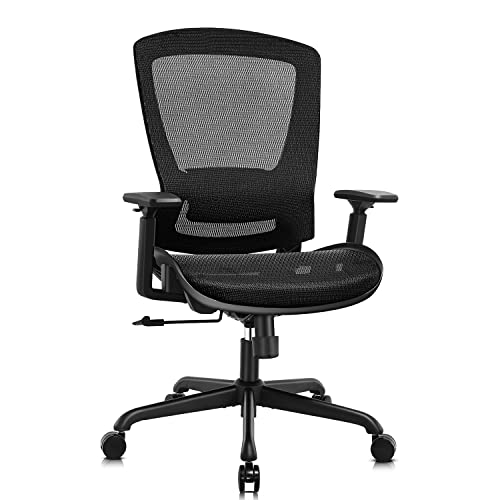
ErgoSift M1 Ergonomic Office Chair with 3.1-Inch Adjustable Seat Depth
$99.99 Check pricePrices change often - Marsail
Marsail Mesh Ergonomic Office Chair with Sliding seat Depth Mesh Desk Chair
$199.99 Check pricePrices change often




How do I check seat depth actually fits me?
Seat pan depth by convention runs about 0.28 times your standing height, minus roughly 2.5 inches of knee clearance, which is meant to leave two to three finger-widths of space between the front edge of the seat and the back of your knee when you sit all the way back against the lumbar support.
Too deep and the front edge presses into the back of your knees, restricting circulation and pushing you to sit forward off the lumbar support. Too shallow and your thighs are unsupported. Chairs with a sliding seat pan let you correct for a mismatch without buying a different chair; fixed-depth chairs do not.
Big and tall: check for X5.11
Shown across the range this category actually spans, from $129.99 to $179.98, rather than the cheapest few.
- HYLONE
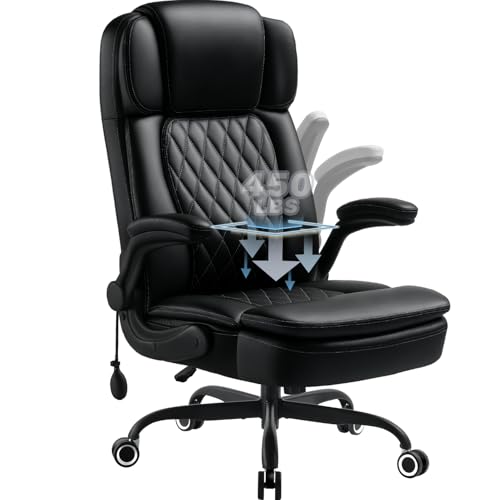
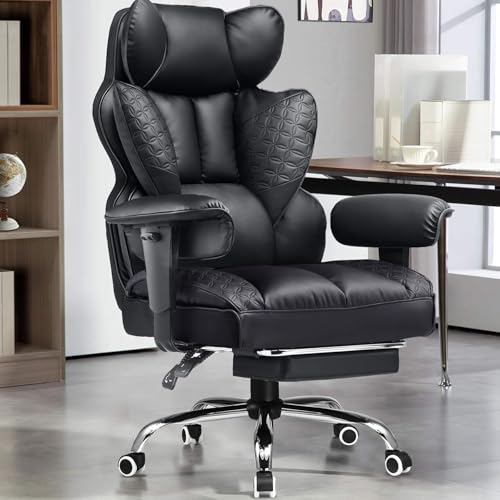
HYLONE 400lb Office Chair Big and Tall,Desk Chair with Lumbar Support,Black
$147.99 Check priceRated 400 lb by the manufacturer Prices change often




Where should the armrests and lumbar support actually sit?
Armrest height by convention lands around 0.145 times your height above the seat pan, close to where a relaxed elbow already rests. The goal is armrests that support the forearm without shrugging the shoulders up or dropping them down, which ties directly into the 90 to 120 degree elbow range from published posture guidance.
Lumbar apex, the point where the backrest curve pushes into your lower back, sits around 0.115 times your height above the seat pan for most adults by convention, though this is worth adjusting by feel since lower back curvature varies more between individuals than the other dimensions.
| Dimension | Ratio of height | Example at 5'8" (68 in) |
|---|---|---|
| Seat height | 0.25 x height | about 17.0 in |
| Seat pan depth | 0.28 x height minus 2.5 in | about 16.5 in |
| Armrest height above pan | 0.145 x height | about 9.9 in |
| Lumbar apex above pan | 0.115 x height | about 7.8 in |
Fit accessories
Shown across the range this category actually spans, from $16.96 to $59.99, rather than the cheapest few.
- TranquilRelax
TranquilRelax Memory Foam Seat Cushion for Office Chair, 3-Inch, Black
$16.96 Check pricePrices change often - BlissTrends
BlissTrends Memory Foam Seat Cushion for Office Chair & Car Seat, Black
$21.99 Check pricePrices change often


What chair category actually fits my body type?
Standard ergonomic chairs cover the bulk of adult body sizes and adjustment needs. Big and tall chairs are built with reinforced frames and wider seat pans and are the category where the X5.1 versus X5.11 distinction above matters most, since these are the chairs where a higher weight rating is actually being claimed. Petite chairs shrink seat depth and lower the minimum seat height for shorter users who find standard chairs bottom out too deep and too high even at the lowest setting.
Executive chairs prioritize appearance and cushioning, often at the cost of the same range of independent adjustments a task-focused ergonomic chair offers. Drafting chairs raise the whole height range for use at a standing-height desk without a sit-stand mechanism, which is a cheaper way to get a tall seated position than buying a full standing desk.
Do I need a premium chair, or does a $150 chair cover the fit numbers above?
The fit ratios above and the posture ranges from the setup guide do not require a specific price tier to hit. A $150 to $250 ergonomic chair with adjustable seat depth, height, armrests and lumbar can land inside every range discussed here. What premium chairs typically add is longer warranty coverage, more refined adjustment mechanisms, and materials that hold up to years of daily use, not a fundamentally different posture target.
Where premium chairs earn their price for some buyers is the range and precision of adjustment, such as independently tensioned recline or a lumbar that adjusts in more than one direction, which matters more for people who spend the full workday at the desk than for occasional use.
What accessories fix a chair that is close but not quite right?
A lumbar pillow adds support to a chair whose built-in lumbar does not reach your lower back curve. A seat cushion changes effective seat height and pan padding for a chair that sits too low or has thin factory foam. A headrest attachment adds support a base chair lacks. None of these change the standard the chair frame was tested to, but they can move seat height, depth and lumbar closer to your numbers without replacing the whole chair.
Get the desk setup checklist
One page: the measurements to take, the order to set them in, and the numbers to check against. Free, no spam.
The mailing list opens shortly. Every measurement it covers is already on this site, in the calculators and the fit tables, at no cost and with no address required.
Questions people ask
Is a chair rated for 300 pounds automatically tested to ANSI/BIFMA X5.11?
Not necessarily. A weight rating on a listing is the manufacturer's claim, and it can be based on X5.1 general purpose testing, X5.11 large occupant testing, or internal testing that does not reference either standard by name. Look for the specific standard number in the product documentation rather than assuming a higher weight number implies the more rigorous large-occupant test.
My seat feels too deep even after sliding it forward. What does that mean?
It likely means the chair's minimum seat depth setting is still longer than the roughly 0.28 times height minus 2.5 inches convention suggests you need. This is common for shorter users on chairs designed around an average or larger frame. A petite-category chair, built with a shorter maximum seat depth from the start, is usually a better fit than trying to compensate with a cushion.
Do mesh and foam chairs meet different standards?
No, seat material is not what ANSI/BIFMA X5.1 and X5.11 test. Both standards test load capacity, durability and stability regardless of whether the seat and back are mesh or foam. Mesh versus foam is a comfort and temperature preference, covered separately in the mesh vs foam chair comparison, not a certification difference.
Why does the same chair model list different weight capacities in different places?
Retailers sometimes round or restate a manufacturer's figure, or list a maximum design load that differs from the certified test load for a specific standard. When the numbers disagree, treat the manufacturer's own spec sheet, ideally one that cites a specific ANSI/BIFMA standard and number, as the reliable source over a retail listing.
Should I buy a chair before or after my desk?
Before, if at all possible. The setup guide covers this in detail: the chair should be fitted to your body first, then the desk height set to match your seated elbows. Buying the desk first and hoping a chair fits it afterward is backwards from how the adjustment order actually works.
Is a higher price always a sign of better ergonomics?
No. Price often tracks materials, warranty length and adjustment precision more than it tracks whether a chair covers the core fit ranges in this guide. A $200 chair with adjustable seat depth, height, armrests and lumbar can hit every number here; a $600 chair without a seat depth adjustment may not fit a given body better despite costing three times as much.